Tunes in the key of A major
General mountain dulcimer or music discussions
I tend to agree with Rob- tuning to EAA would make it much easier to play in A. Cross-tuned fiddlers do the same kind of thing.
updated by @strumelia: 03/10/17 10:20:59AM
I tend to agree with Rob- tuning to EAA would make it much easier to play in A. Cross-tuned fiddlers do the same kind of thing.
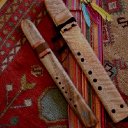
The next step after condor bass are the Drones. Though I recommend starting with the smaller holes as blowing into 2 chambers is quite the challenge and takes practice, the smaller one is a B minor made by a Canadian (Templewindflutes)and the large on Is a G# . It arrived 2 days ago all the way from Australia (MagicWoodworks)
Wow, those are beautiful Monica!
Actually, I have a double flute that my friend gave me that is the V type, in the key of F#. It was made by a fellow in Michigan and has wonderful intonation, tone and craftsmanship. She wasn't using it, so she generously gave it to me. It's been fun to mess around with.
The next step after condor bass are the Drones. Though I recommend starting with the smaller holes as blowing into 2 chambers is quite the challenge and takes practice, the smaller one is a B minor made by a Canadian (Templewindflutes)and the large on Is a G# . It arrived 2 days ago all the way from Australia (MagicWoodworks)
Yes, a string and a tuner will work well to set the fret positions.
If you advertise a JI scale dulcimer as "may not play well with others" and an explanation of what JI is, then it should sell readily to folks who appreciate the JI scale but may not be able to build, or who play only for themselves without other instruments around.
If you build Equal Temp, then it will sell to any tom, Dick or Jane who likes the look of your work.
Laurel -- when I google "dulcimer tuning beads", your avatar photo here shows up!!
marg: between the Bridge and end of the dulcimer, the strings slope downwards. If you have a bead on that string, and push it towards the end, it will slightly tighten the string.
Well, you do have a G$ on the melody string IF you are tuned to DAA and have a 6 1/2 fret. For my work with a band, however, I'd rather re-tune. EAA is my choice for playing in A; indeed, I have a book of tunes for EAA [shameless self-promotion there.] For some tunes, however, I don't retune from DAd. June Apple is one of those tunes, You'll Never Leave Harlan Alive is another. Also, if you're tuned to DAd then you can tune the bass string up to E and have a great Am/A dorian tuning. I don't like a capo because it cuts off lower frets. I know, dulcimerroo, this hasn't really answered your question. But do y'all re-tune or just play in one tuning?
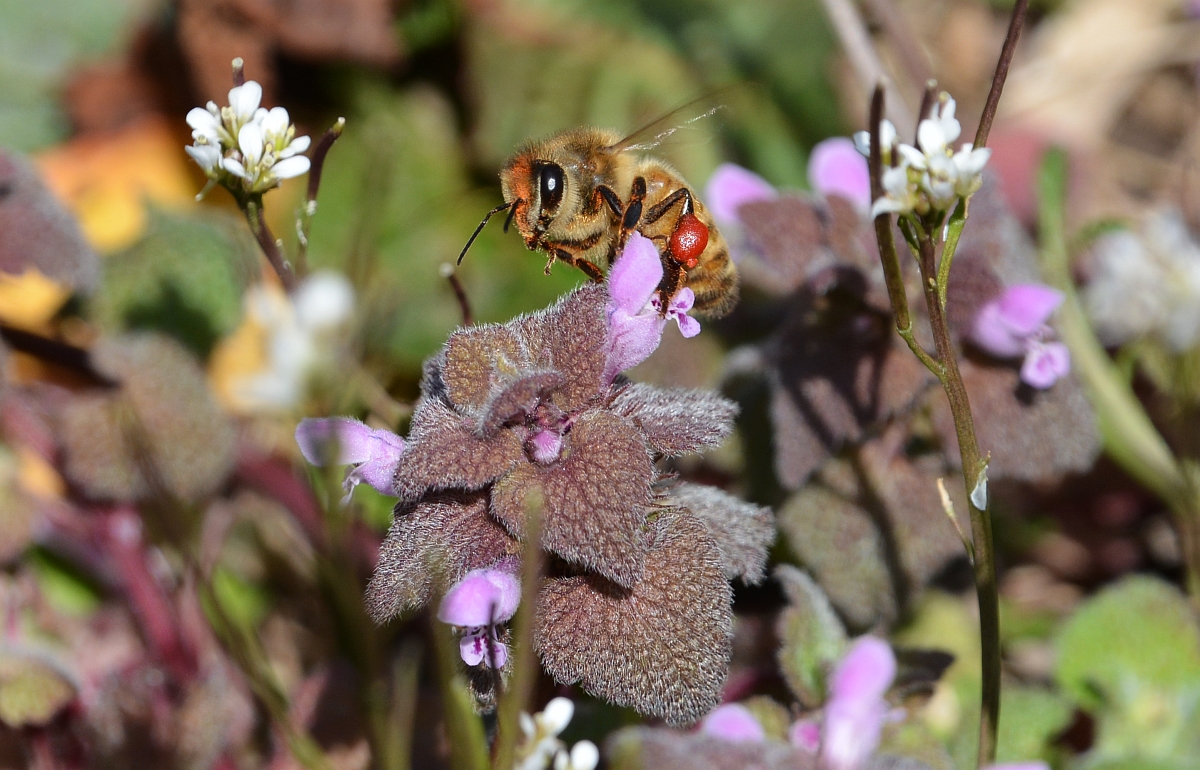
OK, I'm guessing by the red nectar and the red 'hair' on this little honey bee that Dead Nettle pollen is red.
Yeah...sometimes I'm switching between several keys and hate the bother of a capo. 
Since I use three fingers to barre, my fingers don't mind having something to do. 
That's true about starting on the bass string. So, yeah, you can start at the 4th fret on the bass string and go up a whole octave before getting to Do on the melody string.
We're probably driving some people crazy, Dusty!  It was probably a short trip for 'em, anyway.....
What Jan is showing here is that you can play in A even without using a capo. If you use a capo, though, it can be even easier. All the 4s in her chords would essentially be open strings requiring no fingering at all.
Additionally, if you think of the Do as residing on the bass string, and you play across the strings rather than staying on that one string, you can go up an octave and a half without moving out of 1st position.
This is really long (and boring to a lot of people), but you might find it helpful.
Coming from a background of playing by ear on the piano, I like to just move my hands to a new starting place on the fretboard--as much as possible--rather than retuning or using a capo. The folks I play with in Tucson always play "Boil 'Em Cabbage Down" first through in D, then G, then A and then back to D again with nary a measure or a rest in between. Of course, that's a pretty simple tune, but it got me familiar with all 3 keys. Now I often play in A when I'm at a jam with a bunch of fiddlers or other people that want a tune played in a particular key.
If you're just playing 3 chords, the I chord (A) is barred at 444 or else played 44 6+ (I start with the bass string when I write the numbers and 6+ is 6 1/2.). You can play it higher up as 6+78. The octave is barred at 11.
The IV chord (D) is 457 or 757. Higher up, play it with 779.
The V chord (E) is 545 or 86+8, or barre it at 888. There's no G# when you barre at the 8th fret, but you can let your brain fill in "what's missing" here....the brain actually does that very well!
A scale of the I, IV, and V chords plays them in this order: I V I IV I IV V I . Try playing the three chords and singing up the scale...you'll see it harmonizes very nicely. (also try it in keys of D and in G)
To play a scale in the key of A going all the way up from Do to Do (an octave), you'd play:
444 545 446+ 457 6+78 779 86+8 11 11 11
I V I IV I IV V I
Do Re Mi Fa Sol La Ti Do
Notice that except for "Ti" the melody string plays do re mi right up the scale when you play the chords this way. "Ti" is played on the middle string.
Does this help? I mostly play by ear, so I'm not "classically trained" in any instrument, but this sounds pretty good to me.
My apologies if I wasn't supposed to capitalize Do Re Mi...
If the order of the I, IV, and V chords seems impossible to remember, it's a little easier when you realize that Do, Mi, Sol, Do are all I chords. Or, in scale degrees, that would be 1 5 8 1 or the interval a singer always seems to sing when they're warming up (at least in cartoons!).
The next thing that I think really stands out is that the V chords are played Before and After Do--at both ends of the octave. So you'd use a V chord if you're going up FROM Do, or up TO Do (the octave). And likewise, if you're going down FROM Do or down TO Do. If it's next to Do, play a V chord!!!
The others are IV chords. In my mind I think of the scale in three sections:
I V I IV I IV V I The I and V chords look kind of like bookends holding up 2 pairs of alternating books.
Hey! I'm a very visual person, too! I hope this hasn't all been lost in formatting glitches. If you want this sent as an email, just let me know!
Hope it helps! Jan Potts
Good info Dusty, thanks!
So, I guess a capo at 4th enables one to play some tunes in A but not others, while needing to get the G# on the middle string. I think chords would be a bit of a bear to work around, and the lack of G# on the melody string would really bum me out. 
Dusty, if you capo on the 4th, you also won't have the G# available on the melody and bass strings- you'll only have a G natural on those outer strings- it'd be like not having the 6.5 fret.
That's true, but if you need it, you can get the note on the middle string.
Kitchen Girl has a minor part and a major part. And Road to Lisdoonvarna is indeed in a minor key. But with the capo at 4, the 6+ fret functions as a 1+ fret, giving you the minor third note of the scale.
Definitely true, which is why it is so difficult to play in other keys out of a standard dulcimer tuning. I generally retune to get other keys. But the capo can help for G and A. The very first tune I ever saw played on the dulcimer is Stephen Seifert's Whiskey Before Breakfast video on YouTube. He plays the song with the capo at the 4th fret, putting him in A major. I regularly play Indian on a Stump and Booth Shot Lincoln in A using the capo at 4. It may not work for every tune, but it works for a lot of them.
dshombert is selling a dulcimer here on FOTMD & his photos listed looks like it has something like beads you have discussed here. Is that what they are?
Sorry Strumelia, just reread your post. We usually only use the capo if we need to play in a minor key but also for one or two tunes in G. As you point out it does not work for A tunes well.
Does anyone have a photo of how these beads work, I'm not sure I understand where or how or why.
thanks
Thanks again for the comments Strumelia and Dusty.
Trying tunes in A is more of an exercise in finger dexterity in reaching for the G# and also seeing what can and can't be done, we play melody and drone for the most part and play melody only if with other instruments. But endless tunes in D with the occasional G gets boring and retuning in the middle of a session out of the question.
I play with an Old Time String band and we often play A tunes, as Dusty pointed out, for the most part I play melody and chords only when the melody is too fast or too difficult, but I play by ear and could not honestly tell others what I do it just comes natural and if what I do sound bad I change it. When pitted against a room full of guitars and banjos mistakes on the Dulcimer go pretty much unnoticed.
I have a few dulcimers & some have 3 strings & some have 4 & one has 5 & one has 6.
The ones with only 3, I took one of the melody strings off because I finger pick with one of the dulcimers & the other just sounded better with 3.
The ones with 4, sound good that way & I don't have any trouble with pull offs, hammer on's is still a problem no matter if it's 3 or 4 strings. Still working on the force & position to the string, also which finger works best & depending on where my fingers need to go afterwards.
As everyone is saying 'personal preference ' but also the dulcimer may have a say in what works best for it. If I was building a dulcimer I would go with 4 strings, that way the player can decide what they think works best for them.
Cripple Creek's store has been closed since a flood when through the area but the have a FB & I read they said they would still answer questions
Dusty, if you capo on the 4th, you also won't have the G# available on the melody and bass strings- you'll only have a G natural on those outer strings- it'd be like not having the 6.5 fret.
(Kitchen Girl and Road to L. both sound more like minor, not major tunes to me?- with no sharps?)
You can capo on 3 to get the key of G successfully IF you have the 6.5 fret because that gives you your needed C#. But unless I've missed something obvious, capoing to 4 won't give you the right whole/half steps to play in A major.
Dulcimers have certain whole/half fret placements that mean you can't just move a capo up and down to get any key you want- unless it's a chromatically fretted instrument like a guitar, banjo, or a chromatic dulcimer.
So the easy answer here is indeed to capo at the fourth fret and play everything you know for the key of D. You'll be playing in A. Folks do that sometimes to match the keys of standard tunes at old timey or bluegrass jams. Kitchen Girl, for example, is usually played in A, as is Salt Creek. Sally Goodin', Sourwood Mountain, and more.
What I don't get is the motivation here. Are there songs you want to play in A or do you just feel like playing in A for the fun of it?
Gary Gallier has arranged a few tunes in A out of a standard DAd tuning. But those are some pretty fancy tunes with very careful picking. Since the D note is found in both the D and G chord, that low string sounds OK when you play in D and G, but it will be out-of-place in A, so you have to be really careful and only hit that bass string when you are playing a D chord. When you are playing an A or E chord you cannot hit that open bass string at all.
See Gary's arrangements of Kitchen Girl and Road to Lisdoonvarna from the tablature page of his website .
Personally, when I want to play in A I use a baritone dulcimer tuned AEa. Simple, huh?
I'm not understanding how that's going to work on DAd tuning. Are you planning to make chords on all your strings, or just pick out the melody on one string?
How do you plan to make the needed I,IV,V chords in A major on a DAd tuned dulcimer?
And if you capo on 4 to get to the key of A, you won't have the needed G# on the melody and bass strings.
Thanks for the responses all! 
To explain we tune DAD and have 6 1/2 frets that gives us a G sharp on the middle string, so we have just short of two octaves starting on the open middle string to the 2nd fret and then working up the melody string. I am fortunate in that I play by ear and can pretty well play any tune I can hum or whistle, but some of our group need tabs to play. Not wishing to make work for myself I hoped to find tunes in A major already written out saving me the chore.
Yes, this is really interesting!
I was thinking of designing, for a JI fingerboard, a sound box to set a blank fret-board on top. I would rig a dulcimer string to stretch over it to mark off the notes using an electronic tuner, and then cut in the fret slots... I wonder if it would work.
So... if I was going to build a dulcimer with the idea that I would offer it for sale, would it be better to have the scale in Equal Temperament or Just Intonation?
I have D-major-itis... After a few years of fretting over the situation (pun not intended) I decided I was fine with playing almost always in D Major.
That said, Strumelia asks a good question!
Have you addressed how you all will tune and/or capo your dulcimers in order to play in the key of A major?
WOW, WHAT AN EDUCATION.....and how many master's in Music Education know this cool stuff? thank you for something to really think about. I've found 5 old dulcimers, not by famous makers....and some didn't sound right while playing them after i strung 'em up. NOW I KNOW WHY. However, until I learn another style, I prefer the noter and drone style. thanks everyone for what is written here. aloha, irene
Can any one point me to tunes in score and tabs in the key of A major? Our group has vast numbers of tunes in D fewer in G but we would like to try our hand at the key of A.
My dulcimers are EQ and pass my ear test, sounds sweet to me!
When this subject comes up and several N/D players start singing the praises of the JI I think it's important for someone, in this case me, to pipe up and say that the JI is far too limited a scale to hold value for me. ....for reasons I've posted before.
Bob - no one but a custom builder would make a you a pre-slotted JI fretboard, certainly not Folkcraft. I had DanC make me a JI fretboard with staple frets for my last build. There's a JI calculator here on FOTMD to create your own JI pattern for any VSL you want.
My HS Em Condor Bass in Spanish Cedar arrives on Monday. 
I went with cedar, because I have a mid-tone G in cedar, and I love its tone. I have a couple walnut flutes already.
Well, it arrived 3 days late, since the post office decided to send it on a wild journey to an incorrect post office (it was correctly addressed). It got about 650 extra miles on it, but finally arrived today. I love the flute, wood, and tone. Thanks for everyone's help. Happy camper! 
Are the pre-slotted fingerboards sold by Folkcraft Just Intonation or Equal Temperament?
(I am planning to make a JI finger board using an electronic tuning meter to locate fret positions...)
I play mostly by/for myself, and love the JI dulcimer I built last year.
Just found this discussion- it is so interesting.
I know this may sound sorta silly, but back in the day (okay, okay...two years ago, haha!), my friend and I attended a day long time with Joe Collins. We were newbies but obsessed and had never had anyone show us exactly how to do a proper pull-off. Joe showed the class specifically how to do a fine and dandy pull off and you should have seen my friend and me turn our heads, look at each other with jaws dropped and a big ol' lightbulb go KAZAM! over our heads, haha!
Sometimes it's the little things. 
Fifteen or so years ago, at the Southwest Dulcimer Festival in Dewey, AZ, I had an impromptu "lesson" with Robert Force, Alan Darveaux and Stephen Seifert at some picnic tables under some trees at the Bean Tree Farm. My first dulcimer festival, and here's wacky old Noter & Drone Ken, picking and grinning with one of the dulcimer gods and two other fabulous players!
Tell us about the single LIVE workshop or music lesson that was the most musically inspiring to you in your music life. Could be on any instrument- but tell us about how that teacher's in-person lesson or workshop made a big impression, opened a door to your progress, or inspired your music playing in some profound way.
I signed up for a series of 6 classes that will start on March 16... Taught by NY folk musician George Ward. I'm looking forward to that!
It's now about seven months since I started playing the penny whistle, and I'm still really enjoying it!
Lately I've been playing in the key of Bb on my lower plastic whistle- trying to play harmony parts to Brian's fiddling tune melodies on his 'Bb fiddle'. That sounds kind of pretty when I can get harmony passages right. Still working hard at it, as it's not easy for me! Maybe in a few weeks I'll be able to record a little video of that without tons of mistakes...(one or two mistakes is always acceptable in my view.)
I threw together a new social fun site for anyone who plays tin whistle and is interested in joining: